Growing Up Healthy in the Digital Age
Published:

For thousands of years, human beings lived in motion. We walked, climbed, carried, built, farmed, played, and worked outdoors. Our bodies evolved to thrive under sunlight, to grow strong bones and muscles through physical challenge, and to maintain balance, flexibility, and resilience through our daily activity. But in the 21st century, something has changed dramatically: the rise of the digital age has pulled children, and us adults, away from movement and into a life of screens.
When the World Stands Still
Across Indonesia, and especially in urban centers like Jakarta, it’s increasingly common to see families sitting silently in restaurants, everyone, from parents to toddlers, absorbed by their own device. Children no longer run, climb, or play outside as much as they used to. Instead, they live indoors, entertained by screens and surrounded by artificial light and air-conditioning.
What seems like harmless convenience has hidden costs. Physical activity, sunlight, and outdoor exploration are replaced by long hours of sitting. Social interaction — once learned naturally through play, laughter, and shared experiences — is replaced by virtual connection. “Social media” has become a paradox: a space that connects us globally while isolating us emotionally. Many young people struggle to make friends, hold conversations, or build meaningful relationships offline. Human connection, one of our deepest needs, is slowly eroding.

Posture and Physical Development
Doctors are increasingly describing “tech neck” in children, a forward-bent spine and strained muscles caused by long hours looking down at a phone or tablet. Poor posture can lead to chronic pain, headaches, and lasting skeletal issues. Research confirms that children who spend long periods on smartphones often adopt a problematic forward-head posture (Study: Pediatric Smartphone Posture Effects).
At the same time, sedentary habits prevent children from building the motor skills previous generations took for granted, like running, balancing, or even walking long distances without fatigue. Systematic reviews show that high screen time correlates with weaker motor skill development across early childhood (Study: Screen Time & Motor Development Review).

Mental and Behavioral Consequences
And it’s not only the body that suffers. Child psychiatrists, behavioral therapists, and specialized therapy centers are seeing a growing demand as more children struggle with anxiety, irritability, attention difficulties, and social challenges. Large-scale research shows that excessive screen time, especially when combined with reduced sleep and reduced physical activity, is linked with emotional and behavioral problems in children (Study: Screen Time, Sleep & Mental Health).
Sedentary habits and excessive screen time can contribute to emotional and behavioral issues, making it harder for children to regulate their feelings, form friendships, and engage confidently with the world around them.

The Attention Crisis: Fast Media and Fragmented Focus
Beyond physical and emotional effects, today’s digital landscape creates another invisible challenge: shrinking attention spans. Children are growing up with TikTok-style content, fast, stimulating, and designed to trigger instant dopamine release. Their brains become conditioned to expect constant novelty.
Recent findings from Nanyang Technological University show that prolonged social media use is associated with declining focus, emotional fatigue, and compulsive behaviors, especially on short-form platforms (Study: NTU Social Media & Attention).
Behavioral studies demonstrate that heavy users of short-form video platforms exhibit addiction-like usage patterns, returning to the app compulsively (Study: TikTok Behavioral Addiction).
Cognitive research further shows that rapid short-form video consumption impairs prospective memory, the ability to remember and act on intended tasks after a delay (Study: Short Video Consumption & Memory).
Anything slower, quieter, or requiring patience feels “boring” within seconds. This makes it harder for children to focus in class, listen to instructions, or engage deeply with activities that don’t provide immediate reward. Teachers around the world report that students struggle to stay with a task, tolerate frustration, or persist through challenges. When the mind becomes used to rapid scrolling, real life — with its natural pauses and moments of stillness — can feel difficult to manage.

The Role of Parents: Reclaiming Balance at Home
Parents play a crucial role in setting the tone for healthy digital habits and movement. Experts increasingly warn against giving young children unrestricted access to mobile phones and social media. In some countries, such as Australia, social media use is even legally restricted for children under 16. Yet in many families in Indonesia, toddlers and young children already have their own devices. Allowing this without limits can expose children to risks, disrupt healthy development, and make it harder for parents to guide responsible use later. Setting boundaries early is a crucial step in helping children engage with technology safely and meaningfully.
The goal is not to demonize technology, it’s to restore balance. Children learn less from lectures and more from example. When parents put their phones aside during meals or conversations, it sends a clear message: “You matter.” If children see that digital devices are not the center of family life, they learn self-regulation naturally.
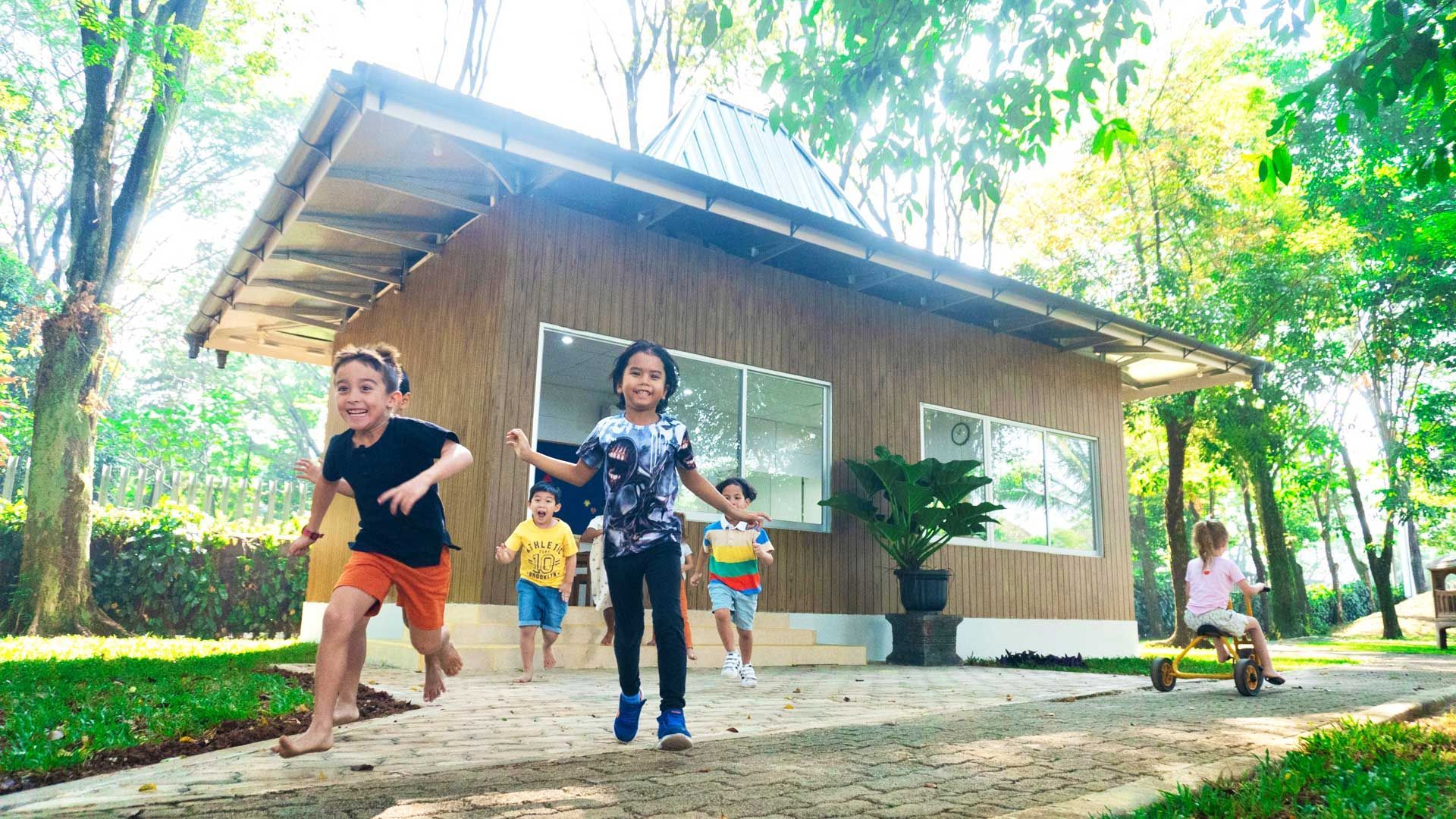
Encouraging outdoor play is another powerful step. Let children ride their bicycles, play football with friends, climb trees, and simply be outside in the sun. Sunlight is not an enemy, it’s a natural source of energy, mood, and Vitamin D, essential for growing up. The belief that the sun is something to be avoided has quietly taken root in many families, yet it is precisely what children need for healthy growth and a balanced rhythm of life.
Creating Space for Movement
Where a family lives plays a crucial role in a child’s ability to stay active. In many urban areas, open and safe spaces are rare. Heavy traffic, pollution, and dense housing make spontaneous play difficult. But if you are fortunate to live in a compound or neighborhood with green spaces and child-friendly streets, use it, let your children explore, play, and interact freely.
Movement does not require expensive equipment or scheduled lessons. It simply needs space and permission. Even small routines — walking to a nearby shop, playing outside after school, or going for family bike rides — can make a difference.
Regular contact with outdoor environments supports not only physical health but also attention and wellbeing; large German field studies and educational assessments highlight the importance of time outdoors for attention, physical activity levels, and readiness to learn (Study: IQB).
National youth surveys also underscore how media habits and living environments shape children’s daily lives and opportunities for active play (Study: Shell Jugendstudie 2024).
Choosing the Right School
Children spend an essential part of their day at school, which means the school’s philosophy, timetable, facilities, and culture strongly influence how much movement, outdoor time, and balanced digital use they experience. A school that prioritizes active learning, scheduled outdoor time, integrated PE, and limits on passive screen use helps counteract sedentary habits formed at home. Research on educational outcomes shows that schools which embed movement and outdoor learning see benefits in attention, classroom behaviour, and overall wellbeing (Study: IQB).
How Deutsche Schule Jakarta Supports This Balance
At the Deutsche Schule Jakarta (DSJ), movement is woven into the daily curriculum and campus design. From the nursery onwards, children learn through play and exploration. As students grow, structured sports, outdoor learning, and extracurricular programs ensure that movement remains part of daily life. Our 4.2-hectare green campus is designed for active learning, with open fields, old trees, playgrounds, a large gym, and two swimming pools. Whether in early learning, primary, or secondary school, DSJ helps children stay connected to their bodies and to nature.
In a time when digital distractions dominate daily life, DSJ offers a space to breathe, move, and grow, helping children find balance between the online and the real world, and learn with mind, body, and soul.

Conclusion
In the digital age, many children are growing up disconnected from their natural need for movement and real human connection. Excessive screen time, indoor lifestyles, and a lack of outdoor play threaten not only their physical health but also their emotional and social wellbeing.
We at Deutsche Schule Jakarta stand against this trend. Through sport, outdoor activities, and a culture of healthy living, DSJ ensures that students stay grounded in the real world. They grow strong, balanced, and confident — ready to face the future with both mind and body in harmony.