IB vs Cambridge vs DIA: Choosing the Right Curriculum for Your Child
Published:
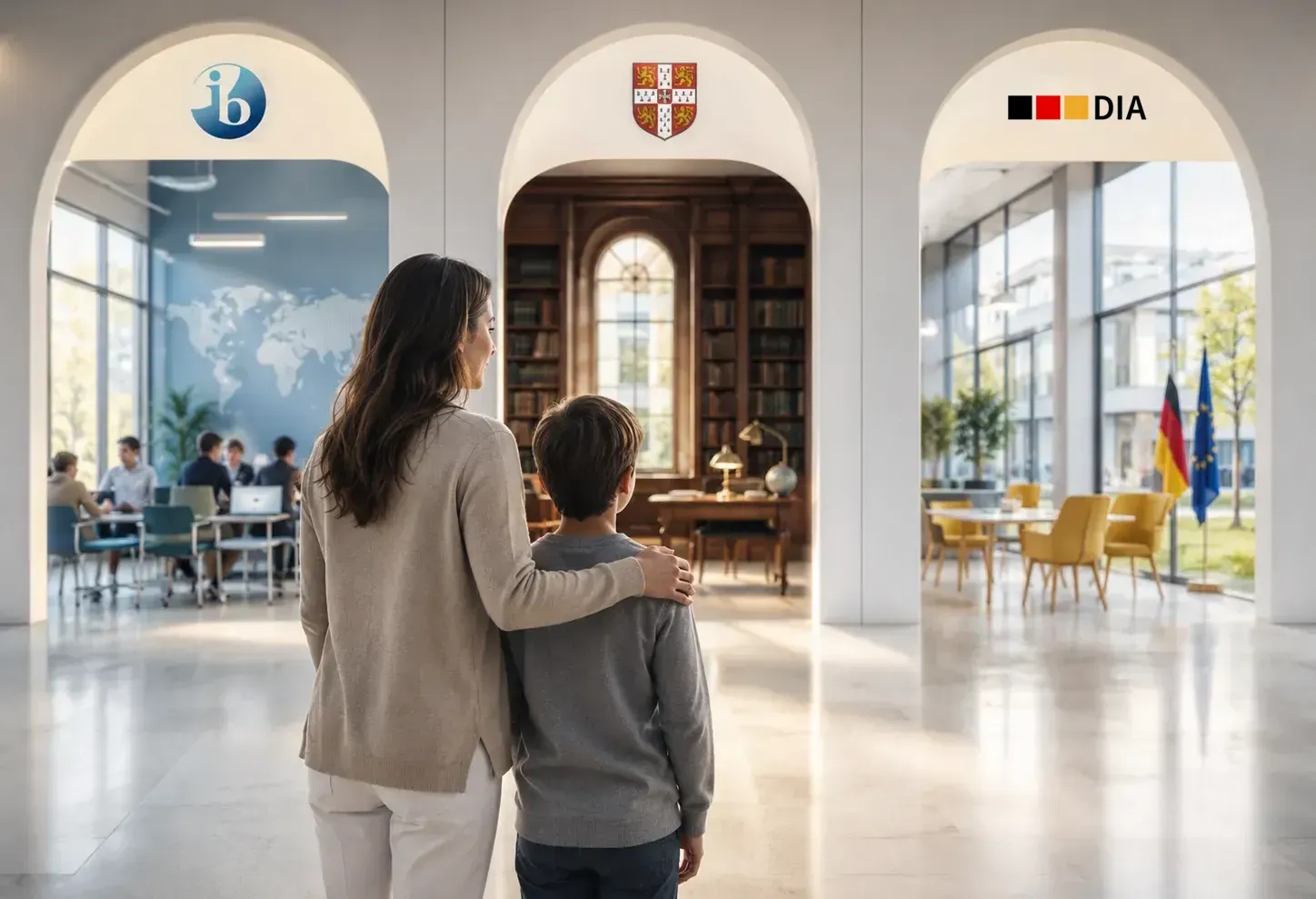
Choosing the right school usually starts with comparing campuses, facilities, and location. But very quickly, a more important question comes up: what curriculum will shape your child’s learning experience every day?
Each system offers a different approach to learning, subject choices, and university pathways. While IB and Cambridge are widely recognised, they are not the only strong academic options. One rigorous but less widely known pathway is the Deutsches Internationales Abitur (DIA), offered by schools such as Deutsche Schule Jakarta.
So how do these three curricula actually compare in practice? While all three can lead to strong university opportunities, they follow different approaches. In this guide, we compare IB vs Cambridge vs DIA, including structure, learning approach, and future opportunities, to help you decide which curriculum best fits your child’s needs.
DIA vs IB vs Cambridge: Key Differences Explained
The following overview highlights some of the key differences to help families better understand how these systems compare in practice.
| Feature | DIA | IB Diploma | Cambridge A-Levels |
|---|---|---|---|
| Educational Approach | Strong academic foundation with emphasis on independent thinking and deep subject mastery | Interdisciplinary learning with focus on inquiry, reflection, and global perspectives | Strong focus on subject mastery and examination performance |
| Subject Structure | Broad subject base with advanced study in selected disciplines | Six subject groups studied simultaneously across disciplines | Typically 3–4 specialised subjects |
| Specialization | Later specialisation while maintaining a broad academic foundation | Balanced subject mix across disciplines | Early specialisation in a smaller number of subjects |
| Final Qualification | Official German university entrance qualification (Abitur) | International diploma combining exams, coursework, and core components | Subject-based examination qualifications (A Levels) |
| University Advantage | Widely recognized internationally + Direct access to German Universities without Prep College | Widely recognised internationally | Widely recognised internationally |
What is the IB Curriculum?
The IB curriculum (International Baccalaureate), developed by the
International Baccalaureate, is an international education system that focuses on critical thinking, inquiry-based learning, and global perspectives. Instead of relying mainly on memorization, students are encouraged to ask questions, explore concepts, and connect their learning to real-world issues.
The most well-known stage, the
IB Diploma Programme (ages 16–19), combines six academic subjects with core components like research, reflection, and community engagement. It is widely recognised by universities around the world and is especially suited for students who enjoy discussion, analysis, and interdisciplinary learning rather than purely exam-focused study.

What is the Cambridge Curriculum?
The Cambridge curriculum,
developed by Cambridge Assessment International Education, is an international education system known for its structured, subject-focused approach and strong emphasis on academic mastery. It is typically divided into stages such as
Cambridge Primary, Lower Secondary, IGCSE (around ages 14–16), and
A Levels (ages 16–19). Students usually study a broad range of subjects early on, then specialise in a smaller number of subjects in the later years, especially during A Levels.
Overall, the Cambridge curriculum is designed for students who prefer clear subject focus and exam-based assessment. It is widely recognised by universities worldwide and is particularly suitable for those who want to develop deep expertise in specific subjects.
What is the Deutsches Internationales Abitur?
The Deutsches Internationales Abitur (DIA) is the German international university entrance qualification awarded by recognised German schools abroad. Academically, it is equivalent to the Abitur in Germany, the traditional qualification required for entry into German universities.
German schools abroad operate under the
umbrella and supervision of the German government, which supports quality assurance, school development, and academic standards across the global network of German international schools. This oversight ensures that the qualification awarded abroad maintains the same academic integrity as the Abitur in Germany.
This distinction is important. The DIA is not a privately designed international curriculum created by an education company. Instead, it forms part of the German education system and follows clearly defined academic expectations.
For families, this means their child is working toward a qualification grounded in a long-standing academic tradition. At the same time, the DIA is delivered in international school environments around the world. Students therefore benefit from both: the structure and academic expectations of the German education system, combined with an international and multilingual learning environment.
There is also an important structural difference worth noting. In some educational systems, not every student automatically completes the most advanced diploma pathway. Depending on academic results, students may graduate with alternative qualifications that can limit their options when applying to universities.
In the Abitur pathway, by contrast, students who complete the program graduate with the
official German university entrance qualification. The final grade still matters greatly – particularly for competitive subjects such as medicine or engineering – but the qualification itself remains a recognised university entrance credential. For families who value both academic depth and long-term flexibility, this can be a compelling advantage.
Which Curriculum is Best for Your Child?
While all three curricula are respected, they are designed for very different types of learners. The right choice depends on how your child learns, what kind of academic structure they thrive in, and where they may want to study in the future.
Choose IB if your child:
- Enjoys discussion, inquiry, and project-based learning
- Is curious and likes exploring ideas across different subjects
- Thrives in a less exam-focused, more continuous assessment environment
- Is aiming for flexibility in
global university options
Choose Cambridge if your child:
- Prefers structured learning with clear subject boundaries
- Performs well in exam-based assessment
- Wants to specialise early in a few strong subjects
- Is targeting
competitive university programs that value
deep subject expertise
Choose DIA (German Abitur) if your child:
- Benefits from a rigorous academic foundation across multiple subjects without early specialization
- Develops best with discipline, consistency, and long-term progression
- Shows interest in analytical thinking and independent learning
- May consider
studying in Europe — especially
Germany — through pathways offered by schools like Deutsche Schule Jakarta
Ultimately, the best curriculum is the one that not only supports your child academically, but also helps them grow into a confident, capable, and future-ready individual in a rapidly changing world.

University Recognition and Global Pathways
For many families, the most important question is what opportunities a qualification creates after graduation. The
Deutsches Internationales Abitur offers two significant advantages in this regard.
First, it provides a
direct pathway into the German university system. Students who graduate with the DIA hold the recognized German university entrance qualification and are treated in admissions as
Bildungsinländer — meaning they have essentially the same standing as students graduating from secondary schools in Germany.
Second, studying in Germany is financially very attractive. Germany has
more than 400 universities, and at most of them
tuition fees are extremely low or entirely absent. Compared with the high costs associated with university education in countries such as the United States, the United Kingdom, or Australia, this can represent a significant advantage for families considering international study options.
In some German federal states, additional tuition fees may apply for international students. For graduates of German schools abroad with the Deutsches Internationales Abitur, however, these fees are typically waived, as they are treated as domestic applicants.
In addition, DIA graduates do not need to take further German language entrance examinations for university admission, as the Abitur already certifies the level of German required for academic study. At the same time, the DIA is not limited to Germany. Graduates of German schools abroad continue their studies at universities across the world, including:
- Germany
- European Countries
- United Kingdom
- United States
- Asia
- Australia
As with any secondary qualification, admission to specific programs still depends on grades, subject combinations, and university entry requirements. But the DIA itself is widely recognised internationally.
Why DIA is Different from IB and Cambridge
Bildung – The German Idea of Education
To understand the DIA properly, it helps to understand a central concept of German education:
Bildung, often described more fully as
ganzheitliche Bildung — holistic education.
Bildung is difficult to translate directly into a single English word. It refers not only to schooling or qualification, but to the development of the whole person. As the German scholar and education reformer
Wilhelm von Humboldt wrote:
“The true purpose of Bildung is the harmonious development of the individual’s abilities, character, and knowledge.”
In this tradition, education is not limited to learning facts or passing exams. Instead, it supports the development of:
- Independent Thinking
- Intellectual Curiosity
- Critical Judgement
- Responsibility
- Resilience and Maturity
This philosophy is particularly relevant today. We live in a time of rapid technological and social change. With the accelerating development of artificial intelligence and other transformative technologies, predicting the exact skills students will need ten or fifteen years from now is becoming increasingly uncertain.
What is clear, however, is that young people will need a strong and
adaptable skill set: analytical thinking, intellectual independence, the ability to learn continuously, and the confidence to engage with complex new challenges. The tradition of ganzheitliche Bildung seeks to develop precisely these qualities.
The Abitur Journey Begins Early
Another common misunderstanding is that the Abitur is simply a final examination taken at the end of school. In reality, the Abitur is the culmination of a
long academic journey. In the German system, this journey traditionally begins when students enter
Gymnasium, usually around grade five. From that point onward, the school pathway gradually builds the knowledge, skills, and discipline that lead to the final Abitur qualification.
At
Deutsche Schule Jakarta, this long-term approach is supported by a
multilingual learning environment. From the early years until grade 6, the school offers an international program designed to seamlessly integrate children from non-German-speaking families. Students initially learn in
English and Indonesian, while
German is introduced step by step.
As students progress into secondary school, German increasingly becomes the main language of instruction. Some subjects continue to be taught in English, and a few Indonesian language classes remain part of the curriculum for Indonesian nationality students. This trilingual approach allows students from diverse backgrounds to gradually develop the language skills required for the Abitur pathway.
Oberstufe — The Final Phase of the Abitur
The final stage of secondary school leading to the Abitur is known as the
Oberstufe. This phase typically includes
grades 11 and 12, during which students move into more advanced academic work.
Historically, the Abitur pathway in Germany lasted
13 years of schooling. In the early 2000s many German states shortened this to 12 years. In recent years, however, several states have begun returning to the 13-year model. At
Deutsche Schule Jakarta, the Abitur pathway currently concludes after
12 years.
During the
Oberstufe, students study a combination of subjects that provides both breadth and depth. They continue to maintain a broad educational foundation while studying selected subjects at a more advanced level. This balance is one of the strengths of the system. Students do not narrow their academic focus too early, yet they still gain serious subject depth and strong preparation for university-level study.
Why the DIA is Less Widely Known
Given its strengths, some parents wonder why the DIA is less widely known than other international curricula. The explanation is relatively simple. In many countries, access to the German curriculum is limited. In Indonesia, for example,
Deutsche Schule Jakarta in BSD City is currently the
only school offering the Deutsches Internationales Abitur. This naturally limits its visibility compared to more widely available international curricula.
German schools abroad were historically established primarily to serve
German expatriate communities. Their mission was to provide education for German families living outside Germany. As a result, these schools did not expand internationally in the same way as global curriculum brands.
Unlike IB or Cambridge, the DIA also does not operate as a commercially marketed curriculum system.
German schools abroad, including Deutsche Schule Jakarta, are typically
non-profit institutions. Their financial resources are reinvested directly into education and school development rather than large-scale international marketing campaigns.
Language also plays a role. While English dominates many international school environments, German is less commonly used globally. Nonetheless, German remains highly relevant internationally. It is the
most widely spoken native language in Europe and continues to play an important role in fields such as engineering, science, philosophy, medicine, and literature.

Why Families Choose the DIA
Families who choose the Deutsches Internationales Abitur often do so for a combination of academic, personal, and long-term reasons. Academic rigor is one of the main reasons families choose this pathway. The German education system is widely known for its high expectations and strong emphasis on deep subject understanding.
Equally important is the focus on
independence and critical thinking. Many parents want their child not only to succeed academically, but also to develop the ability to think independently, analyse complex problems, and take responsibility for their own learning.
The idea of
ganzheitliche Bildung also plays an important role. Education in this tradition supports the development of the whole person – intellectually, socially, and personally. This includes values such as responsibility, environmental awareness, and a balanced school life that recognises the importance of health and physical activity alongside academic achievement.
For many families, the possibility of studying in Germany is also an important consideration. High-quality universities, internationally recognised degrees, and comparatively low tuition costs make Germany an attractive destination for higher education.
Preparing Students for a Rapidly Changing Future
Education today must prepare students for a world that is changing faster than ever before. Technological developments such as artificial intelligence are transforming many aspects of work, knowledge, and society.
Predicting the exact skills students will need ten or fifteen years from now is becoming increasingly uncertain. What is clear, however, is that young people will need strong intellectual foundations: analytical thinking, adaptability, independence, and the ability to learn continuously.
The tradition of
ganzheitliche Bildung underlying the Deutsches Internationales Abitur is designed to cultivate exactly these abilities. By combining rigorous academic training with broad intellectual development, it seeks to equip students not only for university, but for the challenges of a rapidly evolving world.
For families exploring international education in Indonesia, the Deutsches Internationales Abitur (DIA) therefore represents more than another curriculum option. It offers a distinctive educational pathway, one that combines
academic seriousness, global opportunities, and the development of the whole person.
We hope this overview has helped clarify how the Deutsches Internationales Abitur (DIA) works and how it compares with other international curricula. For families who want to explore this pathway further, the best next step is to experience how it works in practice.
Whether you are comparing IB, Cambridge, or other international curricula, gaining a deeper understanding of the DIA can help you make a more confident and informed decision about your child’s future. You can learn more about the school’s programs, approach, and admissions process by visiting the
Deutsche Schule Jakarta website.
Parent FAQ
Is IB more difficult than Cambridge or DIA?
Difficulty depends on the student’s strengths. IB can feel more demanding due to its broad subject load and coursework requirements, while Cambridge can be challenging because of its high-stakes exams. DIA requires long-term consistency and academic discipline.
What age do students start specializing in each curriculum?
In IB, students maintain a balanced subject mix until the Diploma Program (ages 16–19). In Cambridge, students typically specialize earlier during A Levels. In the DIA pathway, specialization happens later while maintaining a broad academic base.
Which curriculum is best for studying in Europe?
The Deutsches Internationales Abitur (DIA) is especially advantageous for studying in Europe, particularly Germany, where it provides direct university access. IB and Cambridge are also recognised but may require additional requirements depending on the country.
Is the German Abitur (DIA) recognized internationally?
Yes, the Deutsches Internationales Abitur is widely recognised worldwide. It is the official German university entrance qualification and also accepted by universities in many countries, including the UK, US, and across Europe.
Can DIA students study abroad?
Yes. Students with the Deutsches Internationales Abitur can apply to universities globally. They also benefit from direct access to German universities without additional entrance exams, especially through institutions like Deutsche Schule Jakarta.